

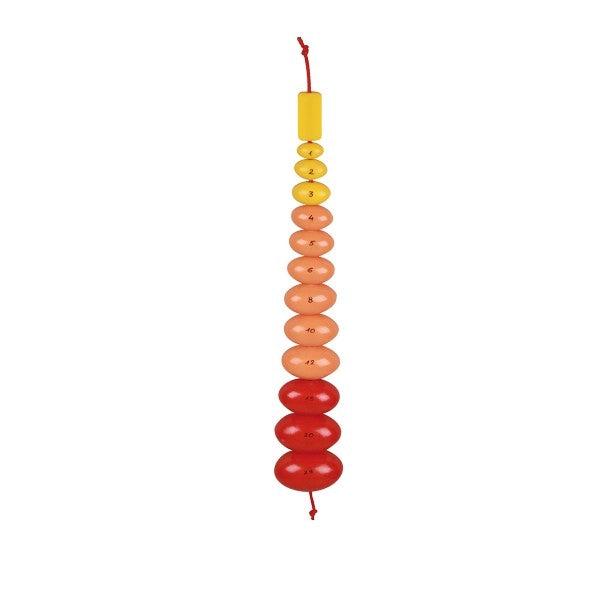
An orchidometer is a clinical instrument used to measure testicular volume. The most widely used version, the Prader orchidometer, consists of a string of 12 colour-coded ellipsoid beads ranging from 1 ml to 25 ml. A clinician holds each bead alongside the patient's testis and selects the bead that most closely matches in size, giving a quick, reliable estimate of volume in millilitres.
Testicular volume is one of the most important markers in paediatric endocrinology and reproductive medicine. It helps clinicians assess pubertal development, investigate fertility problems, monitor hormonal conditions, and screen for genetic syndromes. This guide explains what an orchidometer is, how to use one correctly, what the readings mean, and when testicular volume measurement matters clinically.
In this article
- What Is an Orchidometer?
- How Do You Use a Prader Orchidometer?
- What Do the Volume Readings Mean?
- When Is Testicular Volume Measurement Used Clinically?
- How Accurate Is an Orchidometer?
- Which Professionals Use an Orchidometer?
- How Should You Care for an Orchidometer?
- Frequently Asked Questions
What Is an Orchidometer?
An orchidometer (sometimes called an orchiometer) is a comparison gauge for estimating testicular volume. The standard clinical version is the Prader orchidometer, developed by Swiss paediatrician Andrea Prader in 1966. It remains the gold standard bedside tool for testicular volume measurement more than 50 years later.
The Prader orchidometer consists of 12 ellipsoid beads threaded on a string or chain. Each bead is numbered with its volume in millilitres: 1, 2, 3, 4, 5, 6, 8, 10, 12, 15, 20 and 25 ml. The beads are typically colour-coded by developmental stage:
- Pre-pubertal (yellow): 1 ml, 2 ml, 3 ml
- Pubertal (orange): 4 ml, 5 ml, 6 ml, 8 ml, 10 ml, 12 ml
- Adult (red): 15 ml, 20 ml, 25 ml
The colour coding provides an instant visual reference, making it easy to identify whether a measurement falls within pre-pubertal, pubertal or adult ranges during a clinical examination.
How Do You Use a Prader Orchidometer?
Using an orchidometer is straightforward, but consistent technique matters for reliable results. Here is the standard clinical method:
Step 1: Prepare the patient
The patient should be standing in a warm room. Cold temperatures cause the cremaster muscle to contract, pulling the testes upward and potentially reducing the apparent size. A warm environment relaxes the scrotum and allows a more accurate comparison.
Step 2: Palpate the testis
Gently palpate the testis between thumb and forefinger, stretching the scrotal skin over it. The epididymis sits along the posterior aspect of the testis and should be excluded from the measurement as much as possible, as including it will overestimate volume.
Step 3: Compare with beads
Hold the orchidometer beads alongside the testis, one at a time, and find the bead that most closely matches the size and shape. If the testis falls between two bead sizes, record the smaller value or note the range. Palpation (feeling the testis against the bead) is more accurate than visual comparison alone.
Step 4: Record both sides
Always measure and record left and right testes separately. A difference of more than 2 ml between sides may be clinically significant and warrants further investigation.

Standard 12-bead Prader orchidometer by ESP. Colour-coded beads (1 to 25 ml) for quick, reliable bedside testicular volume assessment. Used in endocrinology, paediatrics and urology clinics.
What Do the Volume Readings Mean?
Testicular volume is a direct indicator of spermatogenic tissue (the Sertoli and Leydig cells responsible for sperm and testosterone production). The readings map to recognised developmental and clinical stages:
| Volume (ml) | Stage | Clinical Significance |
|---|---|---|
| 1 to 3 ml | Pre-pubertal | Normal in boys before puberty (Tanner stage I). If found in a male over 14, may indicate delayed puberty or hypogonadism. |
| 4 ml | Onset of puberty | A testicular volume of 4 ml or greater is the accepted clinical marker for the onset of puberty in boys (Tanner stage II). |
| 5 to 12 ml | Mid-puberty | Progressive increase through Tanner stages II to IV. Growth correlates with rising testosterone and early spermatogenesis. |
| 15 to 25 ml | Adult | Normal adult range. Average is approximately 18 to 20 ml. Values below 15 ml in an adult may suggest testicular atrophy or hypogonadism. |
| Over 25 ml | Macroorchidism | Abnormally large testes. Associated with fragile X syndrome, the most common inherited cause of intellectual disability. |
The 4 ml threshold is particularly important. Testicular enlargement is usually the first physical sign of puberty in boys, appearing before pubic hair, growth spurts or voice changes. This makes the orchidometer one of the most useful tools for confirming pubertal onset and for distinguishing true (central) precocious puberty from other forms.
When Is Testicular Volume Measurement Used Clinically?
Orchidometer-based volume measurement is used across several medical specialties. The most common clinical applications include:
Assessing pubertal development
Testicular volume is the most reliable physical marker for the onset and progression of male puberty. An orchidometer reading of 4 ml or above confirms that puberty has begun. Serial measurements over months or years track whether puberty is progressing normally, too quickly (precocious puberty) or too slowly (delayed puberty).
Investigating delayed puberty
If a boy has not reached a testicular volume of 4 ml by age 14, this meets the clinical definition of delayed puberty. The orchidometer helps clinicians distinguish between constitutional delay (a normal variant where puberty simply starts late) and pathological causes such as hypogonadotropic hypogonadism (Kallmann syndrome) or primary gonadal failure.
Evaluating male infertility
Testicular volume correlates with sperm-producing capacity. Reduced volume (below 15 ml in adults) is associated with impaired spermatogenesis and is a standard part of the male fertility work-up. Andrologists and reproductive medicine specialists use orchidometer readings alongside semen analysis, hormone levels and ultrasound findings.
Monitoring hormonal conditions
Conditions such as Klinefelter syndrome (47,XXY), where small, firm testes are a hallmark finding, are assessed and monitored partly through testicular volume. Orchidometer readings help track response to testosterone replacement therapy and identify testicular atrophy in conditions affecting the hypothalamic-pituitary-gonadal axis.
Screening for fragile X syndrome
Macroorchidism (testicular volume above 25 ml) after puberty is a physical feature of fragile X syndrome. While genetic testing confirms the diagnosis, an unexpectedly large orchidometer reading can be the clinical finding that prompts further investigation.
Monitoring varicocele
A varicocele (dilated veins in the spermatic cord) can cause progressive testicular atrophy on the affected side. Serial orchidometer measurements help track whether the affected testis is losing volume, which is one of the indications for surgical intervention.
How Accurate Is an Orchidometer?
The Prader orchidometer is considered clinically reliable for bedside estimation of testicular volume. Research shows good inter-observer agreement between experienced clinicians, and it remains the recommended tool in RCPCH clinical examination guidelines and endocrinology practice worldwide.
However, there are known limitations:
- Overestimation: Orchidometers tend to overestimate testicular volume by approximately 1 to 4 ml compared with ultrasound measurements, partly because the ellipsoid beads include the epididymis in the comparison and partly because of the difficulty of exactly matching an irregular anatomical structure to a smooth bead.
- Operator variability: Studies comparing measurements between different examiners show that experience matters. Trained clinicians achieve more consistent results than trainees.
- Pre-pubertal accuracy: At small volumes (1 to 3 ml), the difference between beads is small and harder to distinguish, which can reduce precision in the pre-pubertal range.
For clinical decision-making (puberty assessment, screening, monitoring), the orchidometer provides sufficient accuracy. When precise volume measurement is critical (for example, in research or before surgical intervention), testicular ultrasound with dimensional measurements is the gold standard.
Which Professionals Use an Orchidometer?
Orchidometers are standard equipment in several clinical settings:
- Paediatric endocrinologists: Puberty assessment, delayed and precocious puberty investigation, growth clinic reviews.
- Urologists and andrologists: Fertility work-ups, varicocele monitoring, testicular pathology assessment.
- Paediatricians: General developmental assessment, referral triage for endocrine or genetic conditions.
- Reproductive medicine specialists: Male factor infertility evaluation.
- Geneticists: Physical examination in suspected chromosomal or genetic conditions (Klinefelter syndrome, fragile X syndrome).
- Medical students and trainees: The RCPCH clinical examination (MRCPCH) and paediatric training programmes include orchidometer use as a core examination skill.
Professional-grade Prader orchidometer manufactured by ESP. 12 colour-coded beads covering the full 1 to 25 ml range. An essential tool for endocrinology, paediatric and urology departments.
How Should You Care for an Orchidometer?
An orchidometer is a simple, durable instrument that requires minimal maintenance:
- Cleaning: Wipe the beads with a clinically approved surface disinfectant wipe between patients, as the instrument contacts gloved hands and may contact skin during examination. Follow your facility's infection control policy.
- Storage: Store in a clean, dry place. Many clinicians keep theirs in a coat pocket or clinical bag. Avoid exposing wooden or plastic components to excessive heat or moisture.
- Inspection: Periodically check that the string or chain connecting the beads is intact and that the bead numbering is still legible. Replace the instrument if any beads are cracked, chipped or missing.
- Calibration: Orchidometers do not require calibration in the traditional sense, but if used in a research setting, confirm that the bead volumes match the manufacturer's specifications.
Frequently Asked Questions
What is a normal testicular volume for an adult?
Normal adult testicular volume ranges from 15 ml to 25 ml, with an average of approximately 18 to 20 ml. Volumes below 15 ml in a post-pubertal male may indicate testicular atrophy, hypogonadism or impaired spermatogenesis and should prompt further investigation.
At what testicular volume does puberty begin?
A testicular volume of 4 ml or greater is the accepted clinical marker for the onset of puberty in boys. This typically occurs between ages 9 and 14. Testicular enlargement is usually the first visible sign of puberty, preceding pubic hair growth and other secondary sexual characteristics.
Is an orchidometer more accurate than ultrasound?
No. Testicular ultrasound with dimensional measurements is more precise and is considered the gold standard for exact volume measurement. However, the orchidometer is faster, cheaper, requires no equipment beyond the beads themselves, and is accurate enough for routine clinical assessment. Ultrasound is reserved for cases where precise measurement is needed.
Can you use an orchidometer on yourself?
While self-measurement is technically possible, research shows that self-assessment with an orchidometer is less accurate than clinician-performed measurement. The orchidometer is designed as a clinical tool to be used by trained healthcare professionals as part of a physical examination.
What conditions can an orchidometer help diagnose?
Orchidometer findings contribute to the assessment of delayed puberty, precocious puberty, male infertility, hypogonadism (both primary and secondary), Klinefelter syndrome, fragile X syndrome (via macroorchidism), varicocele-related atrophy, and testicular damage from chemotherapy, radiation or torsion.
How much does a Prader orchidometer cost?
A professional-grade Prader orchidometer typically costs between £100 and £200 depending on the manufacturer and material. The ESP Prader orchidometer available from Vena Cava is priced at £162.99. Given that the instrument lasts for years with minimal maintenance, it represents a modest investment for any clinic performing pubertal assessments or fertility evaluations.
For more specialist clinical instruments and medical equipment, browse the full range at Vena Cava.
Equip Your Clinic
Browse clinical instruments, diagnostic equipment and medical supplies at Vena Cava. Trusted by NHS departments and private practices across the UK.
View the Orchidometer →Free UK delivery on orders over £100. Next-day dispatch on in-stock items.
The Vena Cava Team
Written by the clinical and product specialists at Vena Cava Ltd, a London-based medical supplies company. Our team combines hands-on healthcare experience with rigorous product testing to help you make informed choices about medical equipment for home, clinic and workplace use.


